


Does Kazakhstan need a second Ekibastuz?
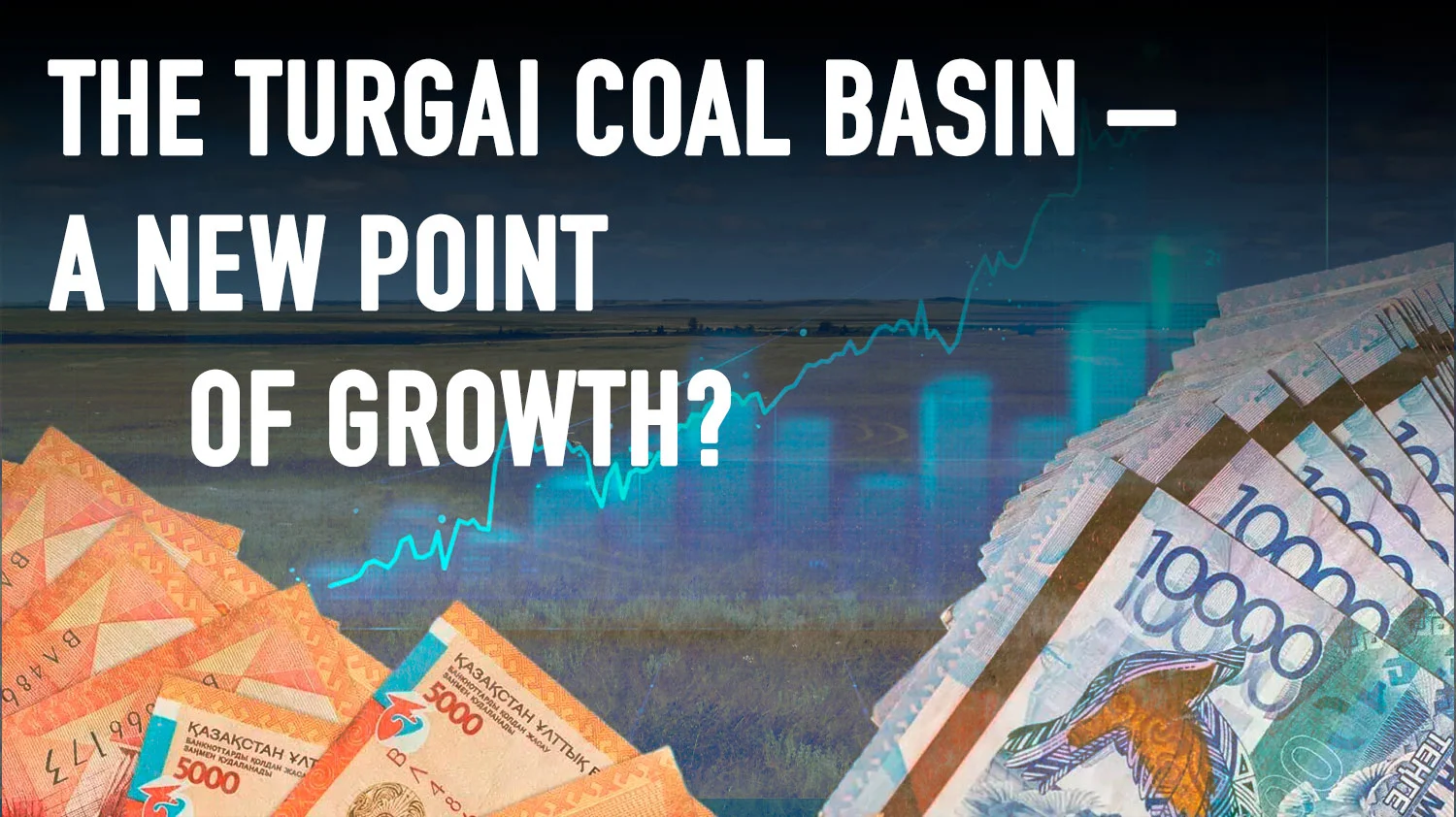
The new Investment Policy Concept through 2030 sets Kazakhstan an ambitious task: to raise fixed-capital investment to 24% of GDP and attract at least $150 bln in foreign direct investment. But the main question now is not how much capital can be attracted. The question is what to invest it in. One possible answer is the project to create the Turgai industrial-agro belt.
At the end of 2025, the Government approved a new Concept of Kazakhstan’s investment policy through 2030. The document marks a transition to a new investment cycle: the task set is to bring the ratio of fixed-capital investment to GDP to 24% by 2030 and to ensure a gross inflow of at least $150 bln in foreign direct investment.
The figures are impressive. But investment alone does not create an economic breakthrough. Blns of dollars can be attracted while the economy’s structure stays the same – exporting raw materials, importing technology and equipment, and agreeing to let most of the value added leave the country.
That is why the new investment policy must answer a harder question: which projects can change Kazakhstan’s economic structure?

From attracting an investor to searching for big projects
The new investment-management system envisages a three-tier vertical accountable to the Head of State. The Council for Investment Attraction, chaired by the Prime Minister, is meant to serve as the central decision-making platform; the Investment Committee of the Ministry of Foreign Affairs and its front offices abroad are to be responsible for finding and attracting investors; and Kazakh Invest is to act as the national operator. Regional akimats are given a key role in shaping investment needs and supporting projects on the ground.
But institutional architecture is only half the job.
For the new model, it is fundamentally important to learn not only to find investors for existing projects, but also to shape projects capable of interesting major international capital.
That is precisely why, among the tasks of the new investment policy, the most important is the search for large anchor projects comparable in scale and economic return to Tengiz, Kashagan, or the development of Astana.
The new investment policy aims to shift from the old resource-based model of attracting capital toward technological and infrastructure investment. Priorities named include energy and nuclear power, oil-and-gas chemistry, transport and logistics, metallurgy and critical minerals, chemical and processing industries, and digital infrastructure. Special attention is given to sectors with high export potential capable of ensuring long-term economic growth and resilience.
This raises an interesting question: are there projects in Kazakhstan capable of simultaneously solving industrial-technological, energy, infrastructure, and agricultural tasks?
One possible answer is the development of the Turgai coal basin.
The Turgai coal basin – a new point of growth?
The Turgai lignite basin is one of Kazakhstan’s largest under-developed resource areas. Total lignite reserves are estimated at 61.9 bln t, of which around 7.1 bln t could potentially be extracted by open-pit mining. For comparison, reserves of the Karaganda basin are estimated at 42 bln t, and those of the Ekibastuz basin at 9.7 bln t.
However, Turgai’s appeal is not defined by coal reserves alone.
The geological features of the deposits create an opportunity for gasification of the coal seams. According to estimates made, the potential gas resources recoverable using CTG technology could exceed 100 trillion cubic meters.
For reference. CTG (coal-to-gas) technology for producing synthetic gas from coal is being actively developed in China. According to China’s 2026–2030 development plan, coal-to-gas output is set to reach 9.4 bln cubic meters a year by the end of 2026, and up to 28 bln cubic meters a year by 2030.
At the same time, lignite contains significant concentrations of critical elements – titanium (15–17 kg/t), germanium (0.5–10 kg/t), lithium, and other rare and rare-earth elements, whose extraction could let Kazakhstan become a leader on the world market.
In other words, this could be about more than building yet another coal-fired power plant – it could be about creating a multi-sector fuel-and-energy and resource-technology complex.
That is a fundamentally different matter.
From a thermal power plant to an industrial cluster
Given all of Turgai’s appeal, why hasn’t it been developed before? The most obvious problem with Turgai has long been known – water.
The Turgai River cannot supply a large energy complex with the volume of water it would need. Its annual flow in the best years is about 200 mln cubic meters, with more than 90% occurring in spring. By comparison, the large Ekibastuz power plants (GRES) consume roughly 90–100 mln cubic m of water a year. No local source can provide that much water for thermal power plants of such capacity.
Why is creating a Turgai fuel-and-energy cluster timely?
There is a serious power shortage in Kostanai region – today more than 75% of needs are covered by inflows from other regions. Local authorities plan to close the gap by 2030 by building six new renewable-energy power plants. Building generation capacity of its own based on the Turgai basin could fundamentally change the situation not only in Kostanai region, but also in Akmola and North Kazakhstan regions and the growing Astana agglomeration.
At the same time, coal gasification could create an additional gas source for the growing macro-region. If CTG technologies for capturing and injecting CO₂ into coal seams are used, the project’s carbon footprint could also be viewed in an entirely different technological configuration.
Thus, the energy project becomes the first element of a much larger system.
Critical minerals: the project’s second layer
The second component is critical materials.
Global demand for such resources is growing fast, and Kazakhstan is already on the radar of major foreign investors. On the initiative of the Head of State, joint research centers are being set up with Germany and Korea to study deposits of rare and rare-earth metals and their subsequent development.
In this context, the Turgai basin deserves particular attention.
According to estimates made, lignite contains 15–17 kg of titanium per tonne and 0.5–10 kg of germanium per tonne, along with lithium and other rare elements. Burning the coal at a thermal power plant is seen as a necessary technological stage for enriching and subsequently extracting these valuable components. For a 1,000 MW plant, the potential for extracting titanium and germanium is estimated at more than 400t a year. If these estimates are confirmed by comprehensive geological and technological studies, Turgai could become of interest not only to energy companies but also to producers of critical materials. The project’s returns would become comparable to the investment involved and would offer clear payback horizons.
And that is an entirely different class of investment project.
Water as the key to industrial development
The third element is water infrastructure.
Near Astana, construction is under way on the Buzuluk reservoir (the Yesil counter-regulator), whose design capacity is estimated at up to 800 million cubic meters. Historically, the project had a broader purpose: as far back as 1968, famous scientist Sh. Chokin considered using this hydro facility to replenish the water-scarce Turgai river basin.
This called for building a roughly 40-km canal from the Yesil River to the Saryozen River (a tributary of the Turgai), capable of transferring 1.5-2 bln cubic meters of water a year. According to calculations, such a system could not only solve the water-supply problem for the energy complex, but also create conditions for irrigating about 1.5 mln hectares of agricultural land.
And here another unexpected opportunity emerges.
The Turgai energy project could simultaneously become an agricultural development project.
Energy, gas, water, irrigation, the production and processing of agricultural raw materials, and new transport infrastructure could all be combined into a single system.
That is precisely why it would be more accurate to speak not of developing the Turgai coal basin and building a new fuel-and-energy complex, but of creating the Turgai industrial-agrarian belt.
Why now?
A fair question can be asked: if Turgai’s potential has long been known, why hasn’t the project been carried out before?
The answer lies in the changing economic context.
First, Kazakhstan is entering a new investment cycle in which the state is declaring a shift from primarily supporting investors to actively shaping large projects.
Second, demand for electricity and infrastructure is growing in the northern and central macro-regions.
Third, critical minerals are becoming one of the most promising segments of the world market.
Fourth, the growth of the Astana agglomeration is objectively increasing the need for energy, water, food, and production capacity.
Most importantly, behind each of the proposed directions there is either already investment, or a potential investor showing interest in carrying it out.
Finally, the very logic of investment policy is changing. Priority should now go not simply to projects that create yet another production facility, but to projects capable of forming new economic ecosystems.
Turgai fits precisely this logic.
A second Ekibastuz or something more?
Ekibastuz became one of the symbols of Kazakhstan’s industrial development in the 20th century. The coal basin gave the country an energy base, around which a major industrial region formed.
But simply repeating Ekibastuz today would not quite be the right approach.
The new Turgai should be built on a different model — not as a coal basin with several power plants, but as an industrial-agrarian cluster of a new generation.
Its potential elements could include:
- lignite mining
- power generation
- gas production via coal gasification
- carbon capture and storage technologies
- extraction of titanium, germanium, lithium, and other critical elements
- production of high-value-added materials
- water-management infrastructure
- irrigation
- modern agriculture
- deep processing of agricultural raw materials
- transport and logistics infrastructure
In this way, a single anchor project could give rise to a chain of dozens of related investment projects.
This approach fits the modern logic of developing territorial-economic clusters.
What needs to be done first?
It would be a major mistake at this stage to announce a multibln-dollar project before its economic and technological efficiency has been calculated.
Therefore, the first step should be comprehensive research into the Turgai basin: the geology of the deposits, the feasibility of open-pit mining, coal characteristics, gasification potential, and the content and distribution of rare elements.
The next stage is preparing investment proposals for developing specific deposits by open-pit mining, including Kushmurun, Yeginsai, and Orlovskoye.
In parallel, survey work needs to be carried out and a feasibility study prepared for the Yesil–Turgai canal, along with plans to increase the capacity of the Buzuluk reservoir to 1.5 bln cubic meters.
Only after that can international investors be approached with concrete proposals, in particular for building a 1,000 MW thermal power plant and for projects to extract titanium and germanium from coal-processing products.
According to preliminary estimates, a comprehensive investment program to create the Turgai fuel-and-energy complex could form a portfolio of projects worth more than $15 bln.
The central question of the new investment policy
Ultimately, the Turgai question goes far beyond a single region or a single deposit.
It shows how far Kazakhstan’s new investment policy can move from the quantitative task of attracting capital to the qualitative task of creating new centers of economic growth.
A target of attracting $150 bln in foreign investment can be set. But it is not enough to tell an investor: «We have resources and tax breaks.»
Investors need to be offered a ready-made economic system: resources, energy, water, infrastructure, a market, export logistics, technology, and a clear model for the return on investment — the way countries that have succeeded in attracting foreign investment have done.
It is the state itself that must learn to assemble these elements into a single investment product.
In this sense, Turgai could become a kind of test of the new Investment Policy Concept.
If the state can turn an under-developed coal basin into a technological, energy, and agricultural cluster linked to the production of critical materials and new infrastructure, this will not be just another investment project.
It will be an example of Kazakhstan shaping its own points of growth rather than waiting for foreign investors to find them.
And then the question will no longer be «does Kazakhstan need a second Ekibastuz?»
Perhaps the task is far more ambitious: to create Turgai as a territorial-economic cluster which has never been before in Kazakhstan.
Все комментарии проходят предварительную модерацию редакцией и появляются не сразу.