

The Maga ship could share the Titanic’s fate
US President Donald Trump began his second term a year ago with an unprecedented campaign of lawlessness. As his violence mounts abroad and the body count grows in Minnesota, his open contempt for law, at home and abroad, has only intensified.
Trump marked the first anniversary of his second term with a new torrent of lies and provocations. He repeatedly threatened to seize Greenland by force, warned European allies of punitive tariffs if they refused to endorse his land grab, then abruptly backed off after reaching “the framework of a future deal.”
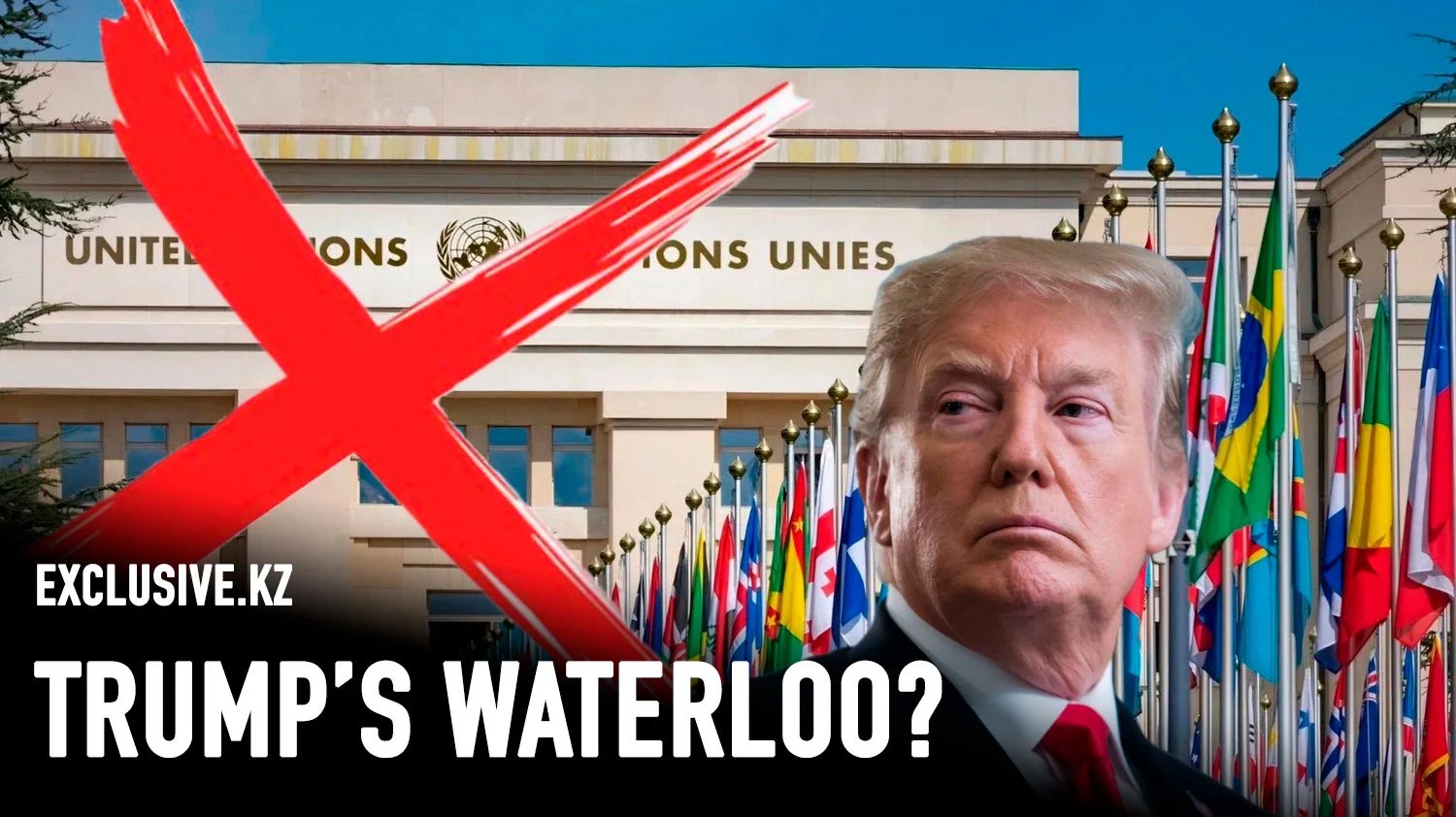
Trump withdrew the United States from 66 international organizations, including 31 United Nations bodies. At home, he escalated his bullying of the Federal Reserve by launching a criminal investigation against Chair Jerome Powell, and claimed absolute immunity for Immigration and Customs Enforcement (ICE) agents who shoot protesters.
Beneath the bluster, however, Trump’s MAGA coalition shows signs of cracking. Trump’s approval ratings have fallen to historic lows amid growing voter dissatisfaction with his handling of the economy and immigration. Some normally compliant Republican legislators have started to show faint signs of resistance. And soon after the Supreme Court rebuffed his attempt to deploy National Guard troops to Chicago, even prominent Trump supporters condemned what they surprisingly labeled ICE’s “Gestapo” tactics in Minnesota.

While these developments have eroded Trump’s political support, his intervention in Venezuela may end up being the straw that breaks the camel’s back. When historians look back on Trump’s rule, they may well mark January 3, 2026 – the day American troops stormed Venezuela and captured its leader Nicolás Maduro and his wife, killing dozens of Venezuelan and Cuban soldiers in the process – as the beginning of the end.
Trump’s removal of Maduro and announced efforts to control Venezuela’s vast oil reserves embody the toxic blend of unilateralism, militarism, and lawlessness that has come to define his second presidency. His open contempt for the courts, Congress, civil society, and America’s allies has spawned legal uncertainty, policy incoherence, and a growing sense of betrayal among his own supporters.
Even diehard MAGA loyalists have difficulty defending Trump’s blatant corruption. The New York Times has calculated that Trump has raked in more than $1.4 billion since the start of his second term. Nearly every one of his foreign-policy moves appears designed to enrich tech billionaires, oil executives, companies paying off administration officials, or insiders tipped off about sudden policy shifts.
At the same time, the daily signs of Trump’s declining mental acuity have become harder to dismiss. As his domestic and foreign policies pull in conflicting directions, his boundless hubris may prove self-defeating, splintering his political base, eroding judicial deference, and puncturing his veneer of authoritarian invincibility.
Unilateralism, Militarism, Lawlessness
Trump’s governing style has long treated cooperation as weakness, relying instead on unilateral action at home and abroad. Domestically, that impulse has pushed institutional checks and balances close to their breaking point, largely because congressional Republicans have abdicated their constitutionally assigned function. Although district judges appointed by Democratic and Republican presidents alike have issued hundreds of rulings curbing Trump’s excesses, his appellate court appointees have disproportionately sided with him. The Supreme Court has largely declined to impose meaningful limits on Trump’s executive power by abusing the so-called “shadow docket,” which allows the justices to issue emergency rulings without full briefing, oral argument, or explanation.
This stands in sharp contrast to Trump’s first term, when domestic and international institutions often acted as guardrails, containing his unilateral impulses. As I argued in my 2018 book The Trump Administration and International Law, those constraints proved vital to preserving rules-based governance.
But Trump’s loyalists learned from that experience. They began his second term by systematically targeting every pocket of principled resistance, purging career officials who had previously defended the rule of law. Through the Department of Government Efficiency (DOGE), entire agencies have been defunded and more than 200,000 federal workers have been forced out, including roughly 55,000 who were fired. Retaliatory measures against Trump’s perceived political adversaries have proliferated, chilling dissent and coercing universities, law firms, and media organizations to capitulate to his demands.
Trump’s destruction of internal and external constraints has enabled him to advance his unilateral agenda largely unchecked. He has repeatedly invoked emergency powers to impose sweeping and legally dubious tariffs on much of the world – driving America’s effective tariff rate to its highest level since the Great Depression – only to suspend, reinstate, or increase them capriciously, based on vendetta or whim.
Trump’s turn to militarism has been even more striking. During his first term, Trump cloaked himself in “America First” rhetoric and routinely disparaged his predecessors’ foreign entanglements. Still, his taste for unilateral displays of strength led him to rely on performative militarism at home and abroad, presiding over the continuation of the war in Afghanistan and the assassination of Iranian General Qassem Suleimani.
Since returning to the White House, Trump has abandoned even the pretense of restraint, sending National Guard troops to Democratic-led US cities. He has brought the war home, instructing self-styled “Secretary of War” Pete Hegseth to attack the “enemy within” by “us[ing] some of these dangerous cities as training grounds for our military.”
Despite claiming to be a peacemaker – boasting of wars he claims to have ended and coveting the Nobel Peace Prize – Trump has aggressively expanded the use of military force, authorizing strikes in seven countries on three continents. By one count, his administration has carried out 622 overseas bombings, including attacks on Iran’s nuclear facilities using massive bunker-buster bombs; striking the Islamic State in Iraq and Syria, Islamic militants in Nigeria, and Houthi targets in Yemen; and killing dozens of unidentified individuals on alleged Venezuelan “drug boats” in the Caribbean.
This time around, Trump has fused his unilateralism and militarism with the lawlessness that has marked his political and business careers. During his first term, Trump and his lawyers echoed former President Richard Nixon’s infamous assertion that “when the President does it … that means that it is not illegal.” But in his second term, emboldened by a permissive Supreme Court decision granting him sweeping immunity, Trump no longer touts his law-abiding bona fides, instead claiming near-total exemption from any legal accountability.
Small wonder, then, that Trump dismisses international law as a meaningful constraint. Following his rambling speech at the World Economic Forum in Davos, he brushed aside allegations that he was behaving like a dictator by saying “sometimes you need a dictator.” In an interview with the New York Times, he dismissed law as posing any constraint on his power, responding that the only thing that can stop him is “my own morality. My own mind.”
Foreign Policy Without Allies
In Venezuela, Trump’s unilateralism, militarism, and lawlessness converged in what he hailed as a “perfectly executed” operation to capture Maduro. By ordering the use of force against another sovereign country without a declaration of war, congressional authorization, or a credible claim of self-defense, he brazenly violated both domestic law and the UN Charter.
More troubling still, Trump all but confirmed that his Venezuela intervention would be open-ended. Pledging to run Venezuela “until such time as we can do a safe, proper, and judicious transition,” he threatened further military action, including “boots on the ground,” if the US met future resistance. In the process, Trump made explicit his real objective: not preventing drugs from flowing into the US – the pretext he originally offered for capturing Maduro – but securing control over, and profiting from, Venezuela’s oil reserves.
Just how he expects to achieve this remains unclear. Although acting Venezuelan President Delcy Rodríguez reportedly agreed to cooperate with the Trump administration before Maduro’s capture, the remnants of Maduro’s regime and the military are unreliable partners. But a pivot to Venezuela’s democratic opposition would not likely solve the problem. Should Trump shift his support to opposition leader and Nobel Peace Prize laureate María Corina Machado or Edmundo González – the rightful winner of Venezuela’s stolen 2024 presidential election (from which Machado was banned from running) – he has no assurance that they could, or would, use state power to serve his oil-extraction ambitions. And US Secretary of State Marco Rubio could give Congress no assurance regarding the prospect of free and fair elections in Venezuela.
Regardless of who Trump backs as Venezuela’s leader, he will face formidable diplomatic resistance. US allies and the UN have already condemned his actions, and their disapproval will only intensify if Trump attempts to run Venezuela in cooperation with Maduro’s lingering security apparatus.
America’s closest allies appear increasingly inclined to chart an independent course, as they have done in response to Russia’s invasion of Ukraine and the war in the Middle East. Speaking at Davos, Canadian Prime Minister Mark Carney warned that “in a world of great power rivalry, the countries in between have a choice: compete with each other for favor, or combine to create a third path with impact.”
Trump’s preference for short-term transactional deals that privilege American commercial interests over sustained cooperation leave him poorly equipped to navigate this hostile diplomatic landscape. His claim to have ended “eight wars in just eight months” reflects a penchant for declaring peace without meaningful follow-through.
Again and again, this empty approach has collided with reality. During the 2024 presidential campaign, Trump repeatedly claimed he could end the war in Ukraine within 24 hours of taking office; more than a year later, the war continues, as brutal as ever. In Gaza, his aides brokered a tentative ceasefire and a partial Israeli pullback, while making little progress toward a sustainable longer-term settlement. Similarly, the administration has failed to resolve the ongoing conflicts between the Democratic Republic of the Congo and Rwanda, Armenia and Azerbaijan, and Thailand and Cambodia.
Trump’s latest escapade, a “Board of Peace” to oversee the Gaza ceasefire and promote peacekeeping worldwide, pushes his brand of “transactional peacemaking” to its logical extreme. This Trumpian “mini-UN,” in which countries have to buy permanent seats for $1 billion, dispenses with basic rule-of-law safeguards by concentrating financial control and veto power in Trump’s hands alone. Not surprisingly, such an arrangement has found few buyers (aside from Russian President Vladimir Putin, in exchange for unfreezing Russian assets) and would promote neither accountability nor peace.
No Roads Lead to Caracas
The economics of Trump’s Venezuela gambit are as flawed as its legal basis. A one-off military strike cannot unlock the massive future investment needed to restore Venezuela’s oil production. As my Yale colleague Jeffrey Sonnenfeld put it, “the economic incentives for investing in Venezuela’s oil sector are minimal and the potential costs are astronomical.” ExxonMobil CEO Darren Woods was even blunter, calling the Venezuelan market “uninvestable,” owing to the extensive legal and commercial frameworks that would have to be put in place even to determine an investment’s viability.
If Trump is serious about rebuilding Venezuela’s oil sector and increasing production, he would need to commit not only billions of dollars but also to deploy large numbers of US ground troops or paid proxies on an open-ended basis, all without clear legal authority. The US would be forced to function as an occupying power in all or part of Venezuela, drawing the US into just the kind of nation-building effort and forever war that Trump promised to end.
To contain what little resistance a handful of Republican senators could muster, Trump pledged that there would be no US boots on the ground in Venezuela. Should he break that promise and American forces suffer casualties, he will face a stark choice: double down or cut his losses and redirect his saber-rattling and limited military resources toward other distractions, such as Greenland or Iran.
Compounding Trump’s problem, the legal case against Maduro is by no means assured. By executing an illegal seizure, then transferring Maduro and his wife to the US to face federal charges, Trump may have undermined the prosecution before it begins, forcing the Justice Department to prove the Maduros’ guilt beyond a reasonable doubt in a highly public and contentious trial.
That trial will likely stretch on for years in a court Trump does not control, in a city politically hostile to him, where not long ago a jury found him guilty of 34 felony counts. It will play out under a relentless media spotlight, with a defense team prepared to challenge nearly every step Trump has taken so far, invoking head-of-state immunity and prisoner-of-war status, disputing the legality of Maduro’s arrest, and demanding access to classified evidence.
Defense counsel will seize on the discrepancy between Trump’s stated justification for Maduro’s capture – bringing him to justice for drug trafficking – and his efforts to assert control over Venezuela’s oil. They will seek to highlight Trump’s increasingly inconsistent statements and erratic behavior to shift public focus from the legality of Maduro’s conduct to Trump’s.
Even if prosecutors overcome these initial obstacles, they will still face serious problems proving their case in a court that will not simply accept Trump’s version of the facts. The hastily revised indictment no longer claims that the “Cártel de los Soles” – the narco-terrorist cartel that Maduro and his wife Cilia Flores are alleged to have led – is a real, functioning criminal organization. At some point, the court will have to confront the realities of drug trafficking in Venezuela. As the Trump administration’s own 2025 National Drug Threat Assessment pointed out, fentanyl trafficking is driven by Mexican – not Venezuelan – cartels, and Venezuela is neither a major source nor a significant transit country for cocaine entering the US. The same assessment notes that the Tren de Aragua gang, which Trump has repeatedly demonized, is not behind major cocaine shipments and has only a “small-scale,” “street-level” presence in the US drug market.
Against this backdrop, the American public will have to square Trump’s claim that kidnapping and deposing Maduro was necessary to combat drug trafficking with his record of pardoning or commuting the sentences of major drug traffickers and facilitators. Most notably, Trump has pardoned former Honduran President Juan Orlando Hernández, who was convicted of trafficking 400 tons of cocaine into the US, Silk Road dark web founder Ross Ulbricht, and former Binance CEO Changpeng Zhao, who pleaded guilty to violating US money laundering laws. Trump has also commuted the sentence of Larry Hoover, who was serving six life sentences for running a violent drug-trafficking gang active in at least 35 states.
In the end, the Maduros may well be convicted. But by the time the trial concludes, the drawn-out public spectacle will have only made clearer that “drugs” were merely Trump’s pretext for seizing control of another country and its assets. In the end, the military, resource-extraction, and law-enforcement strands of Trump’s Venezuela “strategy” will likely pull in different directions, leaving the US neither safer nor stronger.
The Price of Overreach
As Maduro’s trial grinds forward in Manhattan, Trump’s ill-conceived oil-profiteering scheme could dissolve into a quagmire. To “run” an occupied country of 28 million people in the face of widespread domestic resistance would expose US forces to escalating risks and casualties. Increasingly, Trump’s insistence that the US is fighting drug cartels in Venezuela will evoke memories of past bogus claims that Saddam Hussein’s Iraq was stockpiling weapons of mass destruction.
Over time, the growing disconnect between Trump’s rhetoric and his policies, along with his incompetence and corruption, will become too glaring to ignore. And if and when his tariffs finally end up fueling a surge in inflation, even his staunchest supporters may begin to recognize that he has done little to address their economic anxieties. Faced with mounting economic, political, and legal costs, Trump’s “TACO” (Trump Always Chickens Out) instincts may force his retreat, leaving his party weakened and exposed ahead of November’s midterm elections.
A sustained collapse in Trump’s popularity could finally begin to loosen his grip on Congress. Meanwhile, the Supreme Court may curb his unilateralism, as it already has done in rebuffing his attempt to deploy National Guard troops to Illinois. Before its current term ends in June, the Court could well limit some or all of Trump’s abuse of the International Emergency Economic Powers Act to impose sweeping tariffs, his bid to fire Federal Reserve Board member Lisa Cook, and his defiance of the Fourteenth Amendment’s guarantee of birthright citizenship.
As his authority wanes, Trump will blame others for his failures and lash out against advisers who urged him to intervene in Venezuela. But the responsibility lies with his own hubris and reliance on performative toughness. If current polling trends persist, his lame-duck status will become impossible to ignore, encouraging Republican lawmakers and his MAGA base to begin jumping ship.
No one can predict precisely how Trump’s political base will unravel. But a decisive Democratic takeover of the House in November would likely lead to impeachment proceedings, as happened twice during his first term. If his cognitive decline worsens, Vice President JD Vance and Trump’s cabinet will be repeatedly urged to invoke the 25th Amendment to remove him, which will pit Vance’s sycophancy against his own future ambitions. Congress’s January 6 report noted that as late as January 8, 2021, former House Speaker Kevin McCarthy predicted that a 25th Amendment resolution could pass both houses. CNN reported that even servile Vice President Mike Pence considered invoking the 25th Amendment as leverage in case Trump became “more unstable.”
However Trump’s presidency finally ends, his short-sighted January 3 military adventure in Venezuela should mark a turning point: the day the destructive forces he unleashed, and on which he has so long relied, stopped reinforcing one another and finally turned against him. In hindsight, historians will wonder why Trump chose to make his Waterloo a country that few Americans care about or understand.
Copyright: Project Syndicate, 2026. www.project-syndicate.org



Все комментарии проходят предварительную модерацию редакцией и появляются не сразу.