


When Those in Power Lose Their Moral Compass
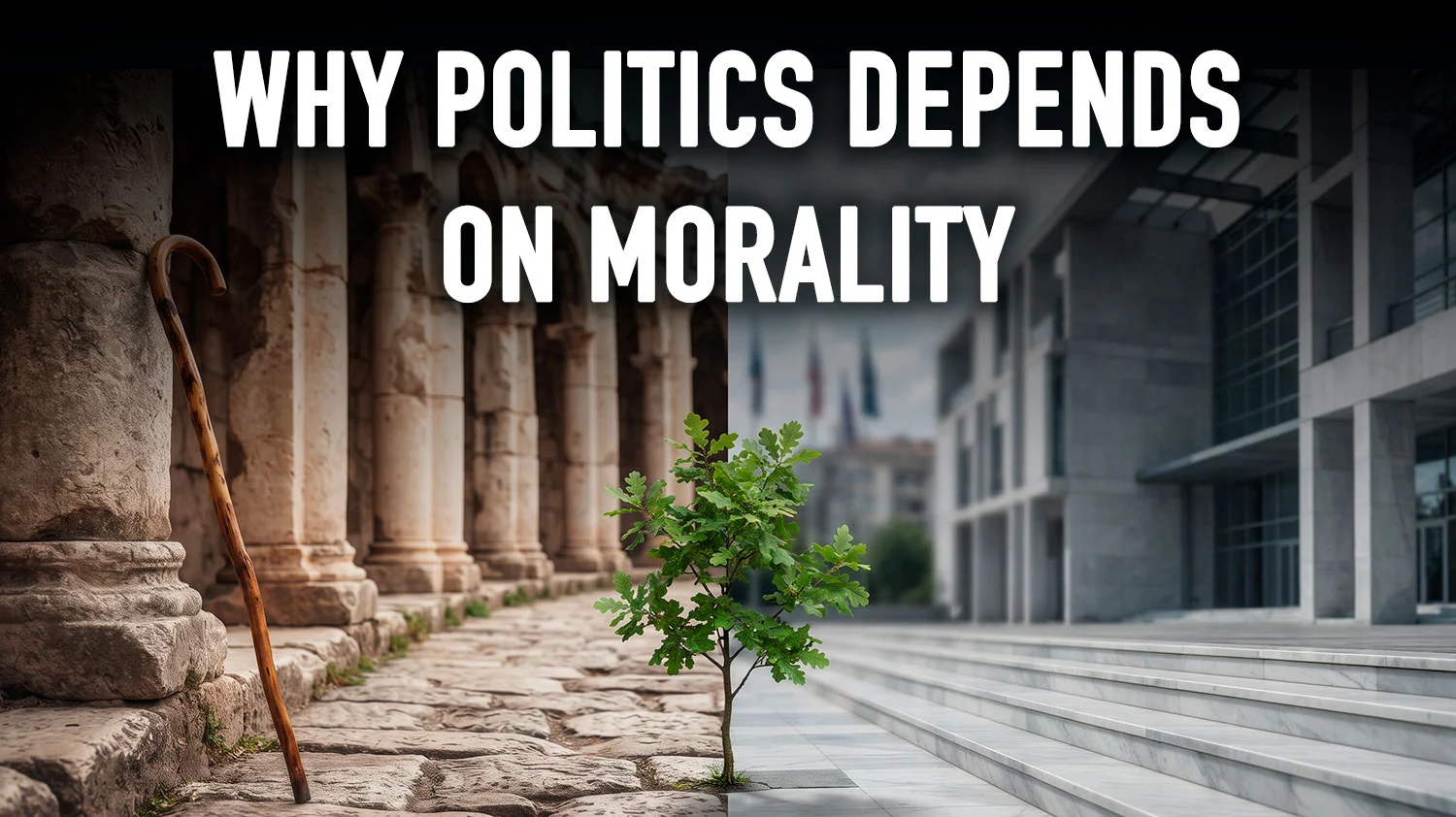
We should have learned by now that good politics depends not so much on good institutions as on the moral sentiments supporting them. If bad or unwise people take over your country by coup or by vote, you can’t rely on your institutions to save you. “Add institutions and stir” has never been a consistent recipe for success; good and wise people are.
It is ethics, good or bad, that guides pretty much all human relationships, from a marriage or a small circle of friends to a sports team, a business, or a nation-state. A meaningful conversation depends on what philosophers call Gricean maxims. A good marriage depends on love and mutual respect. A winning sports team depends on team spirit. A lasting business depends on intrinsic motivations. A successful gang of thieves depends on a code of silence.
In other words, well-designed laws, courts, catechisms, extrinsic motives, social approval, and even a few good and decent people are of no avail if too many people do not behave like self-respecting and other-respecting adults. Childish pride and envy, grabbing more of the sweets, Donald Trump-style, do not make for a good society.
Occasionally a tyrant, such as Peter the Great or Lee Kuan Yew, can coerce a good result from the top down. But classical and modern thinkers from Aristotle and Cicero to George Orwell and Francis Fukuyama have been correct. The functioning of institutions reflects the character of the people.

Cato the Elder defined the virtuous politician as “a good man skilled at speaking,” a character vitally important for any republic, from ancient Rome down to today’s liberal democracies. A good man skilled at speaking, such as former US President Barack Obama, refines the discourse. Equally, a bad man skilled at speaking, such as Trump, corrupts a democracy.
If people lack a virtuous concern for the res publica, no institution–not even James Madison’s clever separation of powers, or the cleverer idea of peer review in science–can ensure good outcomes. The republic of politics, said Alexis de Tocqueville, and the republic of science, said Karl Popper, both depend on self- and other- and transcendence-respecting ethics.
Economists and political scientists, though, have long held a materialist bias, and practical people have been charmed by it. Consider the unrealistic, ethics-free ethics of “realist” foreign policy, whose message amounts to: “Spare us the moral lecture: we’re scientists. It’s embarrassing to consider good and bad.”
Yet ethics obviously should not be set aside in disciplines like economics and political science. True, an astronomer does not need to consider the ethics of galaxies, because galaxies do not adopt fiscal austerity or go to war over an insult. Yet even astronomers need to consider the ethics of arguing their findings, and social scientists clearly need to consider the ethics of the chattering humans they construe.
Ethical change can produce epochal change. The 16th and 17th centuries brought a transformation in the ethics of arguing findings in natural philosophy–what we now call the scientific revolution. That led to the French Enlightenment, which produced, alongside many fine results, étatisme: the science of state control. With enough understanding, one can predict in order to control–that is, control le peuple. The Enlightenment was decidedly illiberal.
Happily, the 18th century also brought a consequential ethical turn, toward a practice called liberalism. Liberalism was at first Scottish and American. Imagine a world with a scientific revolution but no liberal revolution. It would look like Orwell’s vision of a boot stomping on a human face forever. If ordinary people like Michael Faraday and Thomas Edison had not been permitted to have a go, even science would have been evil rubbish.
Liberalism’s birth year, we Americans maintain, is 1776, but its proper baptism came in 1789, after which Edmund Burke lamented that “the age of chivalry is gone. That of sophisters, economists, and calculators has succeeded.” His ancient social ethics of cheerful subordination to rank, Downton Abbey-style, was replaced, slowly, by our plebeian social ethics of mass egalitarianism. Its bumper sticker is “No Involuntary Masters.” There would be equality merely of permissions. That is what the protesters in Tiananmen Square in 1989 and Tahrir Square in 2011 called for. That is all the feminist protesters in Iran wanted: permission.
But after 1848, a new liberalism and a more radical socialism proposed a different bumper sticker: “No Deserving Poor.” Claiming that it was achievable only with state coercion, New Liberals and socialists set up new masters, taking most of the gross national product for state purposes. They denied that equality of permission sufficed to raise up the wretched of the earth. They were mistaken. Since 1800, humanity’s collective lot has improved by 3,000%, largely thanks to “No Involuntary Masters.”
Statism was a mistake. We need governments for a few good purposes, such as protecting us from Russian nuclear extortion. But in a world of greatly varied human gifts and irremediable conditions, the statists’ promises of equality of outcome or of opportunity are not even approximately feasible. To pretend otherwise is deeply irresponsible.
Copyright: Project Syndicate, 2026. www.project-syndicate.org
Cover illustration generated using AI




Все комментарии проходят предварительную модерацию редакцией и появляются не сразу.