


Brazil’s Chapter in the Anti-Authoritarian Playbook
Until President Luiz Inácio Lula da Silva staged a remarkable comeback to win re-election, no Brazilian presidential candidate had overturned a first-round defeat in a runoff. Lula did so with nearly 52% of the vote, against Flávio Bolsonaro’s 48%. More than 128 million Brazilians turned out–nearly three million more than in the first round.
The result matters far beyond Brazil. US President Donald Trump will be unhappy, and not just because his favored candidate lost. The outcome might also send a signal ahead of the US midterms.
It isn’t the first. After years in which nationalist and illiberal movements appeared ascendant, their opponents are finding ways to fight back. Hungary’s Viktor Orbán was defeated in April after 16 consecutive years in power. On the same day as Brazil’s vote, Serbian President Aleksandar Vučić conceded defeat in a snap election held after nearly two years of protests.
Hungary’s opposition was led by a former conservative insider, and Serbia’s by a student-led movement. Yet their experiences suggest an emerging anti-authoritarian playbook. And now Brazil, where democracy has been repeatedly tested in recent years, may have written its most instructive chapter.

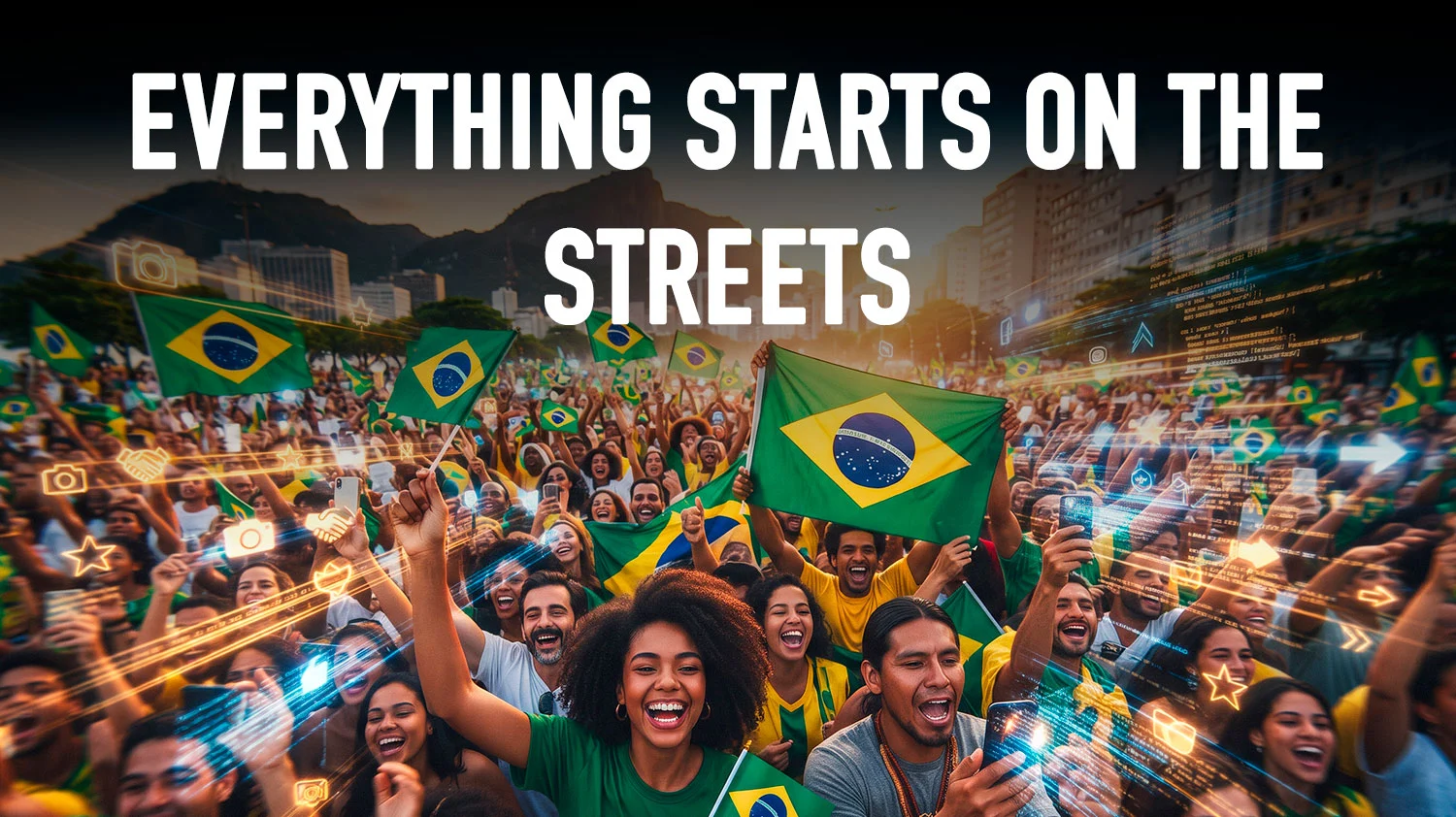
It begins in the streets. In the weeks before Brazil’s runoff, enormous crowds gathered in cities across the country. Students marched alongside workers. Artists and Indigenous leaders joined pensioners, farmers, and entrepreneurs. Many were motivated less by loyalty to a political party than by concern about what another Bolsonaro presidency might mean for democratic institutions and civil liberties.
There was something strikingly spontaneous about the mobilization. Lula acknowledged that he had never seen anything quite like it in five decades of political life. Much of the energy came from outside the machinery of parties and unions. Jolted into action by the first-round defeat to Bolsonaro, civil society had rediscovered its capacity to mobilize.
Brazil’s political earthquake was also digital. For much of the past decade, the far right dominated social media, exploiting its appetite for outrage and confrontation. Supporters of Bolsonaro’s father, former President Jair Bolsonaro, were particularly adept at turning WhatsApp groups and online personalities into political infrastructure. The left, with its dependence on televised speeches and conventional party structures, often appeared hapless.
The turning point came partly through André Janones, a federal deputy with a flair for digital spectacle, and Rafael Fonteles, the 41-year-old governor of Piauí, who helped pull Lula into a world he had long resisted, even refusing to own a cellphone. On October 21, he received one from Fonteles and joined Janones’s rapidly expanding WhatsApp operation. A politician whose career began in the factories and union halls of the 1970s was introduced to memes, livestreams, and algorithmic engagement.
Janones’s WhatsApp channel, dubbed Lula’s Army, attracted more than ten million followers. Participants were encouraged to share videos, promote hashtags, and generate an avalanche of online content. Each was also given a simple mission: mobilize at least three more voters.
Political humor proved especially potent. The campaign discovered that ridicule could be more effective than another earnest denunciation. In a televised debate, when Bolsonaro, arguing that crime had risen on Lula’s watch, demanded to know why 73% of prisoners had supposedly voted for him, Lula shot back: “I want 100% of them to vote for me, even your father.” (Jair Bolsonaro is serving a 27-year prison sentence for plotting a coup after he lost the 2022 election.)
The attention economy cannot be conceded to those most willing to exploit it. Digital platforms reward speed and emotional intensity. Democratic movements must understand those incentives, even as they resist the temptation to reproduce the disinformation and intimidation that corrupt so much online political debate.
Brazil’s experience also exposed and challenged the power of the digital platforms themselves. Lula’s campaign accused Meta of favoring his opponent through its algorithms and AI tools. Meta acknowledged technical failures but denied political bias. Brazil’s electoral court ordered the company to apply the same criteria to both campaigns. The court’s scrutiny cut both ways: at one point it briefly suspended Lula’s Army itself.
Companies like Meta and X wield enormous influence over the world’s political conversation, yet their recommendation systems remain opaque. Democratic competition requires transparent rules that are enforced fairly by courts that also protect legitimate speech.
There was another, more symbolic shift, as the left increasingly challenged the far right’s claim to Brazil’s national colors. For years, the green-and-yellow flag had become closely associated with Bolsonaro’s movement. During the runoff, Lula posed in the national soccer team’s yellow jersey as part of a campaign called “The green and yellow is ours,” insisting that patriotism belonged to no party. His army of online supporters followed suit.
Of course, a WhatsApp channel alone does not explain the exceptional turnout that won the election. Lula also benefited from voter dissatisfaction with his opponent, a forceful performance in the campaign’s final debate, a huge late surge of social spending, and concern about democracy. His government offered concrete economic proposals. The campaign’s digital resurgence coincided with its political recovery, but the precise contribution of each is hard to measure.
Nor should the result be mistaken for a wholesale rejection of Brazil’s right. Nearly 60 million people voted for Bolsonaro. His PL party and its allies retain considerable influence in Congress and across state governments.
Although the PL has recognized Lula’s victory, Bolsonaro remains defiant. Like his father, he responded to electoral defeat by challenging the legitimacy of the contest, pledging to organize the opposition and seek disqualification of Lula’s ticket. He also faces a money-laundering investigation, raising the personal stakes of his political survival.
The next four years may prove considerably harder than Lula’s come-from-behind victory. The Brazilian left, heavily reliant on Lula’s extraordinary personal appeal for decades, has struggled to cultivate new leaders. The country needs a politics capable of reaching people who feel alienated from government, including those whose anxiety about crime and economic insecurity make them receptive to authoritarian candidates.
Brazil’s renewed democratic confidence must now be matched by institutional and structural reforms and a willingness to build coalitions beyond the left. Its leaders need to recover some of the civic spirit that animated the campaign without assuming that an election has resolved the country’s divisions.
This is where the lessons from Hungary and Serbia become relevant. Their experiences show that resistance to concentrated power can emerge from different ideological traditions. The common denominator is a public willing to organize and institutions capable of translating mobilization into political change. As more of the world looks to the Global South for political direction, Lula’s campaign may prove even more influential than the European examples.
Robert Muggah, Co-Founder of the Igarapé Institute and the SecDev Group, is a member of the World Economic Forum’s Global Future Council on Cities of Tomorrow and an adviser to the Global Risks Report.
Ilona Szabó de Carvalho is Co-Founder and President of the Igarapé Institute and Founder of the Green Bridge Facility.
Copyright: Project Syndicate, 2026. www.project-syndicate.org
Cover illustration generated using AI

Все комментарии проходят предварительную модерацию редакцией и появляются не сразу.